
Building NUMU: Designing an AI-First POS for Decision Automation in Restaurants
Restaurant operations generate large volumes of transactional and customer data, yet most operational decisions remain manual. Forecasting, pricing, staffing, promotions, and inventory adjustments are typically handled through disconnected tools, intuition, and delayed reports.
The Strategic Question
Design Principles
Resimator established four core principles to guide the development of NUMU:
Intelligence at the Core: AI capabilities needed to be embedded directly into the POS architecture rather than layered on top as analytics or reporting tools.
Automation Over Insight: The system should not only identify patterns, but also decide and act on them without human intervention where appropriate.
Continuous Learning: Models must adapt automatically to changes in customer behavior, seasonality, and operational conditions.
Role-Based Execution: Outputs must be actionable for different operational roles, from owners to frontline staff, without increasing cognitive load.
The Solution Architecture
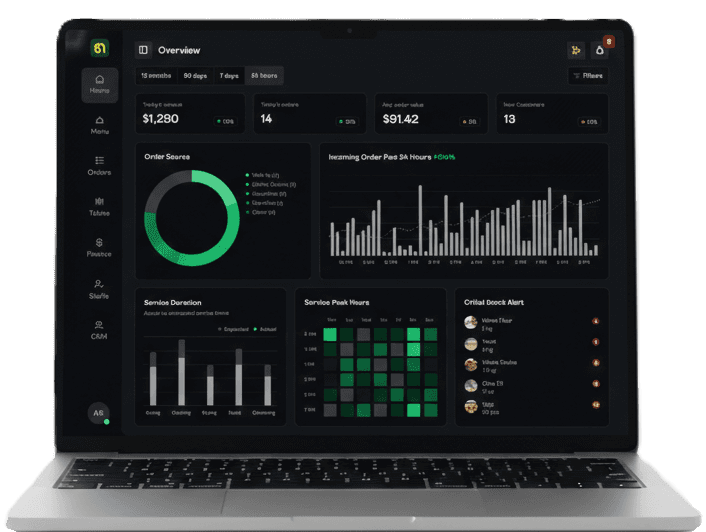
NUMU was architected as a centralized intelligence layer that connects sales data, customer behavior, inventory signals, and marketing activity into a unified decision system. At the center of the platform is the NUMU Automation Engine, which performs four continuous functions:
Observation: Ingests real-time and historical data across transactions, customers, and operations.
Reasoning: Identifies patterns, deviations, and emerging trends using predictive and behavioral models.
Decisioning: Determines optimal actions based on business objectives and learned performance outcomes.
ExecutionTriggers actions such as alerts, recommendations, campaigns, or operational adjustments automatically.
Key Capabilities
Predictive Demand Modeling: Anticipates sales volume and demand shifts using historical data, seasonality, and behavioral signals.
Self-Learning System Behavior: Continuously refines models as new data becomes available, reducing the need for manual configuration or rule-setting.
Real-Time Anomaly Detection: Identifies unexpected performance changes as they occur and explains contributing factors.
Automated Revenue and Marketing Actions: Dynamically triggers promotions, upselling, and customer engagement based on live operational signals
Integrated Operational View: Consolidates operational, customer, and marketing intelligence into a single platform.
Early Outcomes And Observations
While NUMU remains under active development, initial deployments and simulations have demonstrated several consistent patterns:
Faster identification of demand shifts compared to report-based workflows
Improved consistency in decision execution across locations and time periods
Implications For The Industry
NUMU highlights a broader shift in enterprise software design:
From systems of record to systems of action
From human-driven interpretation to machine-driven decisioning
From reactive management to anticipatory operations